| COURSE INFORMATION |
|---|
| Description: |
An introduction to the role of music in the sound track of films.
Although the emphasis is on Hollywood films of the sound era, some discussion of foreign films and silent films is also included.
A background in music appreciation is not needed.
The ability to read music is also not needed.
|
| Location: | FOX M402 |
| Meeting Times | TR, 1030AM-1150AM |
| Prerequisite: | Junior standing |
| INSTRUCTOR INFORMATION |
|---|
| Name: | Charles Francis Leinberger |
| E-mail: | CHARLESL@UTEP.EDU |
| Office: | Fox Fine Arts Center, Room M401B |
| Office Phone: | (915) 747-7800 |
| Office Hours: | Charles Francis Leinberger's Office Hours |
| Biography: | Charles Francis Leinberger's Biography |
| TEXTBOOK |
|---|
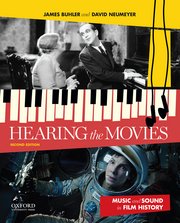
| Textbook: | James Buhler and David Neumeyer:
Hearing the Movies, 2nd Edition (Required) |
|
| Facebook: | www.facebook.com/utepmusicandfilm |
| Also See: | The Internet Movie Database
Plaza Classic Film Festival
|
| Supplemental Reading: |
Jon Burlingame: The Music of James Bond
Robert C. Cumbow: The Films of Sergio Leone
Kate Daubney: Max Steiner's Now, Voyager: A Film Score Guide
Cynthia Farah Haines: Showtime! From Opera Houses to Picture Palaces in El Paso
Roger Hickman: Reel Music: Exploring 100 years of Film Music
Kathryn Kalinak, editor: Music in the Western: Notes from the Frontier
Charles Leinberger: Ennio Morricone's The Good, the Bad and the Ugly: A Film Score Guide
James Wierzbicki: Film Music: A History
|
| Required Equipment: |
Headphones: Earbuds are definitely not recommended.
Students should invest in high-quality headphones.
Noise-cancelling headphones, such as Bose, Sony, and Beats, are very strongly recommended.
Bluetooth-enabled headphones are acceptable but not necessary and may cause a very slight delay between video and audio.
Students will need reliable internet access and a very quiet place to study.
|
| COURSE GOALS, OBJECTIVES, AND TEACHING PHILOSOPHY. |
|---|
| Course Goal: |
- To provide the student with an awareness of the elements of the music that affects our lives every day;
- To provide the student with an understanding of music's history and how music affects, and is affected by, culture and events worldwide;
- To enable the student to discuss how and why music contributes to a better quality of life;
- To foster a life-long love of music and a desire to support music and all of the arts.
|
| Course Objective: |
Upon successful completion of the course, the student will be able to:
- Understand and appreciate the complexities with which sound is used in film and the role of music as one element of a film's soundtrack;
- Understand and appreciate the creation and use of music in cinema as both craft and art;
- Understand the unique challenges that composing for film presents;
- View a film with a critical ear for the film score and not as a passive viewer;
- Appreciate the contributions to the art by those who compose for both Hollywood films and foreign films.
|
| Teaching Philosophy: |
Charles Francis Leinberger's Teaching Philosophy
|
| SCHEDULE |
|---|
| FALL |
|
|---|
| Week |
Days |
Topic |
Assignment |
Test |
| 1 |
T |
Part I |
Buhler and Neumeyer: Introduction |
None |
|
| R |
Buhler and Neumeyer: Chapter 1: The Soundtrack and Narrative |
Quiz 1 |
| 2 |
T |
Buhler and Neumeyer: Chapter 2: The Musicality of the Soundtrack: Concepts and Terminology |
None |
|
| R |
Quiz 2 |
| 3 |
T |
Buhler and Neumeyer: Chapter 3: Music, Sound, Space, and Time: Concepts and Terminology |
None |
|
| R |
Quiz 3 |
| 4 |
T |
Review for Midterm 1 |
None |
|
| R |
Midterm 1 |
Midterm 1 |
| 5 |
T |
Part II |
Buhler and Neumeyer: Chapter 4: From 1895 to 1929: Music and Sound in Early Film |
Begin Writing Task #1: How to Write a Synopsis (pages 83-87)
Example: A Fistful of Dollars Synopsis
Also see Academic Writing |
|
| R |
Quiz 4 |
| 6 |
T |
Buhler and Neumeyer: Chapter 5: From 1926 to 1932: The Transition to Sound Film |
None |
|
| R |
Due: Writing Task #1: How to Write a Synopsis |
Quiz 5 |
| 7 |
T |
Buhler and Neumeyer: Chapter 6: The Broadway Melody, Gold Diggers of 1933, and Le Million: Runtime Segmentation and Scene Analysis
The Dawn of Sound: How Movies Learned to Talk and Okay for Sound |
Begin Writing a Scene Analysis Paper (pages 217-23) |
|
| R |
Buhler and Neumeyer: Chapter 7: From 1932 to 1950: Music and the Sound Track in the Classical Studio Era |
Quiz 6 |
| 8 |
T |
Buhler and Neumeyer: Chapter 8: Mildred Pierce: Writing about Film Sound and Music |
None |
|
| R |
Quiz 7 |
| 9 |
T |
Buhler and Neumeyer: Chapter 9: From 1950 to 1975: The Stereo Sound Track and the Post-Classical Era |
None |
|
| R |
Due: Writing a Scene Analysis Paper |
Quiz 8 |
| 10 |
T |
Buhler and Neumeyer: Chapter 10: Music and Film Form in the Post-Classical Era, Course Drop Deadline |
None |
|
| R |
Quiz 9 |
| 11 |
T |
Review for Midterm 2 |
None |
|
| R |
Midterm 2 |
Midterm 2 |
| 12 |
T |
Part III |
Buhler and Neumeyer: Chapter 11: From 1975 to 2000: The New Hollywood, Dolby Stereo, and the Emergence of Sound Design |
None |
|
| R |
Buhler and Neumeyer: Chapter 12: Music and Film Form in the New Hollywood |
Quiz 10 |
| 13 |
T |
Buhler and Neumeyer: Chapter 13: Music and Film Sound Since 2000 |
None |
|
| R |
Buhler and Neumeyer: Chapter 14: Music and Film Form Since 2000 |
Quiz 11 |
|---|
| 14 |
T |
Buhler and Neumeyer: Chapter 15: Writing about Film Music: Interpretation |
None |
Quiz 12 |
| 15 |
T |
None |
Review for Final |
None |
| R |
| Final |
R |
Parts I, II, III |
None |
Final |